As manchas negras da ONU
Etiquetas: Política mundial


[Carregar nesta imagem para ampliar]
Etiquetas: Política mundial
«Lamentável. Leal, cego, aparentemente servil», disse em Londres o antigo presidente norte-americano Jimmy Carter, a propósito do apoio britânico a George W. Bush na guerra do Iraque. Disse-o, justamente, quando Tony Blair foi a Bagdad e a Bassorá fazer uma última visita às tropas, antes de deixar o cargo de primeiro-ministro, aproveitando para dizer que viu no terreno "sinais de mudança e de progresso".Etiquetas: Política mundial
R
ussian officials suddenly announced on Monday that work on Iran’s nuclear power reactor at the southern port of Bushehr would be slowed due to Tehran’s failure to make scheduled payments on the construction contract. Far from being an ordinary commercial dispute, the delay is another pointer to the extreme tensions produced by the Bush administration’s military threats against Iran.
The Russian announcement came just two days before a UN Security Council deadline for Iran to shut down its uranium enrichment facilities. Tehran, which insists that all its nuclear programs are for peaceful purposes, has refused to comply. The Bushehr reactor, which is being completed by Russian firms, is designed to produce electricity and is not included in the UN resolution.
According to Sergei Novikov, spokesman for Russia’s nuclear agency Rosatom, Iran is behind in its financial commitments. “In February no payments were made. In January we received just $5.1 million of the $25 million due,” he said. Underfinancing, Novikov explained, would influence the agreed timetable, including the delivery of nuclear fuel and the launch of the reactor.
After repeated delays, Russia and Iran agreed last year to a timetable for the reactor’s completion: the delivery of nuclear fuel was due by March 2007 and the launch of the facility in September, with electricity generation to start in November. Now the supply of nuclear fuel will be delayed. According to Andrei Cherkasendko, an official with the Russian state nuclear power company Atompromresursy, operations will probably not commence until mid-2008.
The announcement provoked an angry Iranian response. Muhammad Saeedi, deputy director of the Atomic Energy Organisation of Iran, denied the country had been late in making payments. He insisted that the financial problems lay with the Russian contractor, not on the Iranian side. On Wednesday, Gholam-Ali Haddad-Adel, the speaker of the Iranian parliament, urged Russia to complete the reactor on time and warned that a delay “will have adverse affects on the minds of the Iranian people”.
It is evident that “non-payment” is simply an excuse for the delay. Iran wants to make payments in euros, rather than US dollars, as part of its stated policy of holding reserves and settling accounts in currencies other than the dollar. As part of its campaign against Tehran, the Bush administration has been pressuring European and Asian banks to freeze Iran’s dollar-denominated accounts. Rather absurdly, Rosatom has refused Iranian payment in euros, with a renegotiation of the original contract accordingly.
Several commentators have noted the $1.3 billion contract signed in 1995 is no longer as profitable for the Russian contractors involved. Any renegotiation of the contract could be used to squeeze some more money from Iran. The high-profile project is, however, an important aspect of Iranian-Russian relations. A petty dispute over the nearly completed Bushehr reactor could compromise Moscow’s hopes for further nuclear construction contracts that have been mooted to follow.
The Rosatom decision was obviously a political, rather than a commercial decision. Moscow has repeatedly resisted pressure from Washington over the past decade to pull out of the project altogether. At Russia’s insistence, the international sanctions imposed under a UN Security Council resolution in December excluded the Bushehr reactor. At the same time, the Moscow government is deeply concerned that the Bush administration will exploit the nuclear issue as the pretext for a military attack on Iran and has been pressing Iran to shut down its uranium enrichment and related facilities.
Coming immediately prior to a debate in the UN Security Council on Iran’s nuclear programs, there is no doubt that Moscow is using the Bushehr project as another lever against Tehran. Moreover, Washington is demanding the imposition of harsher economic sanctions against Iran. Russian President Vladimir Putin could be planning to use the delay in the Iranian reactor as a bargaining chip in the backroom haggling between the major powers that will inevitably accompany any new UN resolution.
There may well be other calculations, however. Russia is acutely aware of the danger of a US attack on Iran. A second US aircraft carrier group led by the USS John C. Stennis arrived in the region on Monday, placing two aircraft carriers in the Persian Gulf for the first time since the US invasion of Iraq in 2003. The US has also placed Patriot anti-missile batteries in several of its Gulf state allies. The threatening military build up has been accompanied by an escalating US propaganda campaign against Iran’s nuclear programs and its alleged support for anti-US insurgents in Iraq.
Commenting to the Lebanese magazine Al-Watan Al-Arabi on Wednesday, Russian Foreign Minister Sergei Lavrov warned the US against using its troops in Iraq against other countries in the region, including Iran. “The multinational force in Iraq should abide strictly by the UN Security Council’s mandate, which does not provide for any operations outside the country,” he said. “The escalation of the conflict and its possible spread beyond Iraqi borders will inevitably result in catastrophic consequences and not for the Middle East alone.”
As Lavrov well knows, the absence of a UN resolution did not stop the Bush administration from launching the illegal invasion of Iraq in March 2003, which Russia and the rest of the UN Security Council rubberstamped. Nor will any UN resolution, or lack of one, prevent the White House from attacking Iran.
The BBC reported on Monday that the US Central Command had completed drawing up a list of targets for an air war on Iran, including its nuclear facilities and most of its military infrastructure. Among the list of nuclear targets is the Bushehr reactor, even though its purpose is the provision of electricity and an agreement has been signed to return all spent fuel rods to Russia
In this context, the Russia’s announced delay in the Bushehr project takes on a more sinister aspect. The most critical component of the timetable is the provision of reactor fuel—enriched uranium—which was due to take place next month. Once the fuel is loaded, any air strike on the reactor has the potential to send a plume of radiated dust and debris into the atmosphere affecting not only Iran but neighbouring countries. Russian technicians employed on the site would also be endangered, threatening to provoke an international incident.
The sudden Russian delay raises the obvious question: just what does the Putin administration know about the Bush administration’s plans for a military attack on Iran?
Fonte: Global Research.
Etiquetas: Política mundial
P utin não tem ao seu dispor nada semelhante ao poderio militar de Bush mas não será essa circunstância que o vai impedir de exercer a influência mundial que aspira para a Rússia. Tem outra arma, eventualmente tão eficaz como a militar, para projectar poder para fora das fronteiras: a arma da energia.[1]
Não lhe faltam condições para a poder usar com eficácia. A Rússia tem das mais importantes reservas mundiais em petróleo (o segundo maior exportador do mundo) e gás natural (a maior reserva do mundo, aproximadamente o dobro da do Irão, que tem a segunda maior). Tem, no seu próprio país, uma longa experiência da sua utilização para fins políticos: quer para recompensar vizinhos que não contestam as suas políticas (Bielorrússia) quer para penalizar os que se acham no direito de pensar de forma diferente (Geórgia e Moldova)[2].
Putin tem em andamento, ou prestes a iniciarem-se, importantíssimos projectos de construção de pipelines que lhe vão permitir colocar as capacidades de exportação ao nível da produção. Presentemente, dos sete milhões de barris produzidos por dia apenas quatro milhões são exportados por pipeline; os restantes têm que seguir por caminho-de-ferro ou via fluvial. A disponibilidade de portos de águas profundas é também muito limitada.
Esta situação alterar-se-á com a construção de duas novas condutas. A primeira, já acordada com a Alemanha, ligará um campo de produção de gás na Sibéria Ocidental, passando por Petersburgo e depois através do Mar Báltico até à Alemanha, um projecto que já foi confirmado pela Senhora Merkel[3] e que se espera reduzirá a dependência alemã das fontes de petróleo. A segunda desenvolver-se-á entre a Sibéria Oriental e o Pacífico, num trajecto de mais de 4000 quilómetros, para transporte de cerca de 1,5 milhões de barris de petróleo por dia, para clientes na região do Pacífico/Ásia, incluindo o Japão e, possivelmente, a China.
Foi neste contexto geral, que se assistiu ao recente conflito russo/ucraniano sobre fornecimento de gás natural, no final deste ano. O assunto teve, como não podia deixar de ser, importantes reflexos sobre a Europa e vai, provavelmente, levar a União Europeia a rever as suas políticas energéticas. Aliás, a Áustria, actualmente com as responsabilidades da Presidência, já anunciou a iniciativa da próxima apresentação de um relatório com propostas de eventuais medidas para corrigir a situação de dependência energética em relação à Rússia, que alguns sectores consideram excessiva.
Vejamos, com mais algum detalhe, o que de facto foi a crise energética ucraniana. Aliás, o mais sensato é prepararmo-nos para a sua continuação e prováveis reflexos sobre a Europa.
A Rússia tem fornecido energia às antigas Repúblicas da antiga USSR, hoje Comunidade de Estados Independentes (CIS – Commonwealth of Independent States), a preços muito inferiores ao mercado internacional[4]. Estes fornecimentos pertencem ao mercado da Gazprom[5], uma companhia russa gigante na área da exploração e comercialização de energia, cuja propriedade foi recentemente liberalizada por Putin, mas que, de facto, continua a ser apontada como uma espécie de braço das políticas energéticas russas. É esta organização que o antigo Chanceler alemão Schroeder vai integrar, a convite de Putin, assunto relacionado com a construção da nova conduta de gás para a Alemanha!
A Ucrânia era um dos beneficiários dessa política de preços subsidiados, mas há já algum tempo que se anunciava um provável fim dessa vantagem, estando em cima da mesa, para negociação, preços substancialmente diferentes. A Rússia considerava-se justificada nessa nova medida, em função de critérios de mercado, quer pela sua próxima admissão à Organização Internacional de Comércio, quer pelo reconhecimento da União Europeia de que a Ucrânia já tinha uma economia de mercado. Ninguém, porém, exclui a eventualidade de que o aumento de preços esteja ligado a um desejo da Rússia em fazer pagar, pelo menos em termos económicos, o progressivo afastamento político da Ucrânia da esfera de influência russa, principalmente depois da Revolução Laranja e subsequente inclinação da Ucrânia para o Ocidente, EUA e Europa.
Durante algum tempo, a Ucrânia terá avaliado os trunfos que tinha por seu lado como suficientes para evitar esse desfecho Contava, para tanto, com o facto de ser através do seu território que passa a conduta de gás de abastecimento da Europa (80% da produção russa). Esta situação proporcionava-lhe duas vantagens: argumento para exigir “direitos de passagem”, que contabilizava em 15% do total das vendas de gás feitas à Europa; tornar improvável qualquer corte significativo do abastecimento porque, inevitavelmente, acabaria por acontecer o mesmo à Europa, contratempo que a Rússia nunca poderia dar-se ao luxo de provocar aos seus parceiros europeus.
Complementarmente, a Ucrânia contava poder usar também os dois seguintes trunfos extra: levantar dúvidas sobre a continuação da concessão de facilidades à Marinha russa em portos do Mar Negro e anunciar o abandono da CIS, em favor de uma nova associação de estados desvinculada da Rússia (Community of Democratic Choice) juntamente com a Geórgia e mais sete países, todos, presentemente, da esfera russa.
Nenhum destes trunfos, porém, alterou a posição russa. Sergei Ivanov, ministro da Defesa russo, referindo-se à ameaça ucraniana de reconsiderar as facilidades dadas à Marinha russa, não podia ter sido mais claro: “O acordo sobre as bases de apoio da esquadra do Mar Negro é parte de um Tratado Bilateral, cuja segunda parte inclui o reconhecimento das fronteiras mútuas. Tentar rever esse tratado será fatal”. A Gazprom continuou a exigir o aumento de preço (de 50 dólares por 1000 metros cúbicos para 230 dólares) e, não conseguindo acordo, começou a cortar o abastecimento russo, a partir do dia 1 de Janeiro.
Não foi preciso esperar muito para que os europeus começassem a protestar.[6] Em resposta, a Rússia garante que o abastecimento para a Europa está a ser feito nas condições habituais e acusa a Ucrânia de desviar o abastecimento para seu próprio consumo, enquanto esta garante que estava apenas a usar reservas próprias e a consumir gás recebido do Turquemenistão, o que a Rússia afirmava não ser verdade.
A disputa, porém, não dura muito; resolve-se ao fim de 3 dias, com um acordo de contrato válido por 5 anos[7]. O que terá permitido este relativamente rápido desfecho? Será ele duradoiro?
A Europa, muito dependente da Rússia em termos energéticos, terá tido, certamente, um papel determinante a pressionar o Presidente Viktor Yushchenko para obtenção de um rápido entendimento com a Rússia. Este terá concluído que o apoio que tem tido da administração Bush, muito entusiasta da saída da Ucrânia da órbita russa, não lhe daria a invulnerabilidade de que precisaria. Por outro lado, ser acusado de constituir a origem de uma situação que estava a afectar os interesses europeus, não seria o mais conveniente para um candidato à entrada na União Europeia e na NATO.
Em complemento do papel europeu na resolução da crise, a interdependência existente entre a Rússia e a Ucrânia acabou também por prevalecer como um elemento decisivo para chamar as duas partes a um acordo. Se a Ucrânia não pode dispensar a importação de gás, pois produz apenas 16% das suas necessidades, a Rússia também não tem alternativa para outro percurso de fornecimento de gás à Europa. A Ucrânia abriga a maior comunidade russa a viver fora do país e mais do que uma área de trânsito para as suas exportações de gás ocupa um papel central nas acessibilidades da Rússia às mais importantes ligações, na área, entre o Leste e o Oeste. Os dois países, para bem da estabilidade mundial, estão condenados a entenderam-se. Caso contrário, teremos mais uma área com alto risco de instabilidade.
O que ganharam as partes com esta crise?
A Rússia não conseguiu impor os preços de mercado, mas conseguiu duas vantagens importantes: fez ver aos europeus que, contrariamente ao que fazem os americanos, devem passar a ter em atenção os interesses russos na Ucrânia; mantém sob seu controlo o fornecimento de gás à Ucrânia, uma vez que as condutas dos novos fornecedores[8] passam pelo seu território; estes também ganharam, ao passar a vender o gás a um preço quase duplo do anterior.
A Ucrânia conseguiu evitar a quadruplicação de preços que a Gazprom tencionava impor mas não evitou a sua duplicação, o que levou à queda do governo, cinco dias depois, e ao retomar da radicalização do combate político, tendo em vista eleições em Março. Estarão, então, de novo em confronto as facções pró-ocidentais do Presidente Yushchenko e da sua anterior primeira-ministra Yulia Timoshenko e a facção pró-Rússia do anterior candidato presidencial Yanukovich, que Putin queria colocar no poder, por manipulação das eleições.
Yanukovich, porém, desta vez, tem por seu lado o facto de as facções pró-ocidentais não estarem unidas e, assim, poder beneficiar de uma dispersão de votos. Se for isso o que vai acontecer, então Putin pode reclamar uma das suas mais importantes vitórias. Talvez, os ucranianos possam voltar, então, aos preços baixos do gás mas a contrariedade será grande para o Ocidente e para a metade da população que quer essa aproximação.
A Europa evitou um corte de gás que, neste período do ano, teria consequências penosas. Mas tem frente a difícil tarefa de encontrar soluções mais consistentes e duradouras de diversificar fornecedores, vias de abastecimento e formas de energia. Melhor seria, por isso, que os europeus se dispusessem a encarar de forma diferente o recurso à energia nuclear, mesmo que essa solução não resolva o problema no curto prazo.
[1] Diz Roland Nash, um analista que trabalha para o Renaissance Capital, um banco de Investimentos em Moscovo.
[2] Washington Post, 4 de Janeiro.
[3] A conduta inicia-se no campo de Yuzhno-Russkoye, que se estima conter cerca de um trilião de metros cúbicos de gás natural e terminará em Greifswald.
[4] A preços de cerca de 1/5 dos praticados para o mercado europeu.
[5] Controla 20% do mercado mundial da produção de gás natura, 16% das respectivas reservas e parte significativa das reservas petrolíferas.
[6] Houve reduções de abastecimento (entre 20 e 50%) na Alemanha, França, Itália, Polónia, República Checa, Eslováquia, Áustria, Hungria e Sérvia.
[7] Segundo o qual, a Ucrânia passará a pagar 95 dólares por cada 1000 metros cúbicos de gás proveniente do Turquemenistão, Uzbequistão e Cazaquistão e 230 dólares pelo gás proveniente da Rússia que possa ser necessário lançar no abastecimento.
[8] Turquemenistão, Uzbequistão e Cazaquistão.
Etiquetas: Política mundial
February 11, 2007, Munich
“We are well aware of how the world has changed and we have a realistic sense of our own opportunities and potential. And of course we would like to interact with responsible and independent partners, and work together in constructing a fair and democratic world order that would ensure security and prosperity not only for a select few, but for all.”

Speech at the Munich Conference on Security Policy
Extractos do discurso de Vladimir Putin na Alemanha [discurso completo no link ao fundo da página]
Missile weapons with a range of about five to eight thousand kilometres that really pose a threat to Europe do not exist in any of the so-called problem countries. And in the near future and prospects, this will not happen and is not even foreseeable. And any hypothetical launch of, for example, a North Korean rocket to American territory through western Europe obviously contradicts the laws of ballistics. As we say in Russia, it would be like using the right hand to reach the left ear.
The stones and concrete blocks of the Berlin Wall have long been distributed as souvenirs. But we should not forget that the fall of the Berlin Wall was possible thanks to a historic choice – one that was also made by our people, the people of Russia – a choice in favour of democracy, freedom, openness and a sincere partnership with all the members of the big European family.
And now they are trying to impose new dividing lines and walls on us – these walls may be virtual but they are nevertheless dividing, ones that cut through our continent. And is it possible that we will once again require many years and decades, as well as several generations of politicians, to dissemble and dismantle these new walls?
The latest initiatives put forward by American President George W. Bush are in conformity with the Russian proposals. I consider that Russia and the USA are objectively and equally interested in strengthening the regime of the non-proliferation of weapons of mass destruction and their deployment. It is precisely our countries, with leading nuclear and missile capabilities, that must act as leaders in developing new, stricter non-proliferation measures. Russia is ready for such work. We are engaged in consultations with our American friends.
In connection with this I shall talk about international energy cooperation in more detail. Madam Federal Chancellor also spoke about this briefly – she mentioned, touched on this theme. In the energy sector Russia intends to create uniform market principles and transparent conditions for all. It is obvious that energy prices must be determined by the market instead of being the subject of political speculation, economic pressure or blackmail.
We are open to cooperation. Foreign companies participate in all our major energy projects. According to different estimates, up to 26 percent of the oil extraction in Russia – and please think about this figure – up to 26 percent of the oil extraction in Russia is done by foreign capital. Try, try to find me a similar example where Russian business participates extensively in key economic sectors in western countries. Such examples do not exist! There are no such examples.
I would also recall the parity of foreign investments in Russia and those Russia makes abroad. The parity is about fifteen to one. And here you have an obvious example of the openness and stability of the Russian economy.
And there is still one more important theme that directly affects global security. Today many talk about the struggle against poverty. What is actually happening in this sphere? On the one hand, financial resources are allocated for programmes to help the world’s poorest countries – and at times substantial financial resources. But to be honest -- and many here also know this – linked with the development of that same donor country’s companies. And on the other hand, developed countries simultaneously keep their agricultural subsidies and limit some countries’ access to high-tech products.
And let’s say things as they are – one hand distributes charitable help and the other hand not only preserves economic backwardness but also reaps the profits thereof. The increasing social tension in depressed regions inevitably results in the growth of radicalism, extremism, feeds terrorism and local conflicts. And if all this happens in, shall we say, a region such as the Middle East where there is increasingly the sense that the world at large is unfair, then there is the risk of global destabilisation
What do we see happening today? We see that this balance is clearly destroyed. People are trying to transform the OSCE into a vulgar instrument designed to promote the foreign policy interests of one or a group of countries. And this task is also being accomplished by the OSCE’s bureaucratic apparatus which is absolutely not connected with the state founders in any way. Decision-making procedures and the involvement of so-called non-governmental organisations are tailored for this task. These organisations are formally independent but they are purposefully financed and therefore under control.
In connection with this I would allow myself to make one small remark. It is hardly necessary to incite us to do so. Russia is a country with a history that spans more than a thousand years and has practically always used the privilege to carry out an independent foreign policy.
We are not going to change this tradition today. At the same time, we are well aware of how the world has changed and we have a realistic sense of our own opportunities and potential. And of course we would like to interact with responsible and independent partners with whom we could work together in constructing a fair and democratic world order that would ensure security and prosperity not only for a select few, but for all.
Thank you for your attention.
Etiquetas: Política mundial

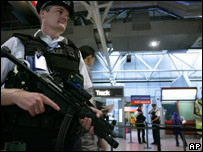
UK 'plot' terror charge dropped
A Pakistani judge has ruled there is not enough evidence to try a key suspect in an alleged airline bomb plot on terrorism charges.
He has moved the case of Rashid Rauf, a Briton, from an anti-terrorism court to a regular court, where he faces lesser charges such as forgery.
Pakistan has presented Mr Rauf as one of the ringleaders behind the alleged plan to blow up flights out of London.
The British authorities say they foiled it with Pakistan's help in August.
They say proceedings against suspects arrested in Britain will go ahead.
'Explosives'
The arrest of Rashid Rauf in Pakistan triggered arrests in the United Kingdom of a number of suspects allegedly plotting to blow up transatlantic flights.
The Pakistani authorities described him as a key figure.
But an anti-terrorism court in Rawalpindi found no evidence that he had been involved in terrorist activities or that he belonged to a terrorist organisation.
As well as forgery charges, Mr Rauf has also been charged with carrying explosives.
But his lawyer says police evidence amounts only to bottles of hydrogen peroxide found in his possession.
Hydrogen peroxide is a disinfectant that can be used for bomb-making if other chemicals are added.
The BBC's Barbara Plett in Islamabad says the judge's decision has reinforced the already widespread scepticism there about the airliner plot.
Several commentators said the threat was deliberately exaggerated to bolster the anti-terror credentials of Pakistani President Pervez Musharraf and that it helped to demonise British Muslims of Pakistani origin.
The Crown Prosecution Service in the UK said the dropping of charges against Mr Rauf in Pakistan would "make no difference" to the case against the men charged in Britain.
'Suspected conspiracy'
In August, the British government requested the extradition of Mr Rauf, a Briton of Pakistani origin who returned to Pakistan four years ago, in connection with a 2002 murder.
Scotland Yard declined to discuss which murder case the request related to.
The government in Pakistan, which has no extradition treaty with the UK, said it was considering the request.
Rashid Rauf was arrested in Pakistan earlier that month over the alleged plot to blow up US-bound aircraft, Pakistan's foreign ministry said.
He has been described by Pakistan's government as a "key person" in the "suspected conspiracy".
The August arrests led to increased airport security around the world, causing major disruption.
Passengers on many flights were forbidden to take liquids aboard aircraft.
Fonte: Link
Comentário: Como se verifica, cai por terra a teoria dos "terríveis atentados evitados em Londres em Agosto, que íam ser piores do que o 11 de Setembro". Alguns meses depois, cá está: Escondido algures no meio dos jornais, sem que quase ninguém repare.
Nunca falha...
Etiquetas: Política mundial

A uranium conversion facility near Isfahan where, according to a statement by an Iranian vice-president last week, 250 tons of gas for the enrichment process have been stored in tunnels;
A heavy water reactor at Arak, which may in future produce enough plutonium for a bomb;
Israeli officials believe that destroying all three sites would delay Iran’s nuclear programme indefinitely and prevent them from having to live in fear of a “second Holocaust”;
The Israeli government has warned repeatedly that it will never allow nuclear weapons to be made in Iran, whose president, Mahmoud Ahmadinejad, has declared that “Israel must be wiped off the map».
Robert Gates, the new US defence secretary, has described military action against Iran as a “last resort”, leading Israeli officials to conclude that it will be left to them to strike.
Israeli pilots have flown to Gibraltar in recent weeks to train for the 2,000-mile round trip to the Iranian targets. Three possible routes have been mapped out, including one over Turkey.
Air force squadrons based at Hatzerim in the Negev desert and Tel Nof, south of Tel Aviv, have trained to use Israel’s tactical nuclear weapons on the mission. The preparations have been overseen by Major General Eliezer Shkedi, commander of the Israeli air force.
Sources close to the Pentagon said the United States was highly unlikely to give approval for tactical nuclear weapons to be used. One source said Israel would have to seek approval “after the event”, as it did when it crippled Iraq’s nuclear reactor at Osirak with airstrikes in 1981.
Scientists have calculated that although contamination from the bunker-busters could be limited, tons of radioactive uranium compounds would be released.
The Israelis believe that Iran’s retaliation would be constrained by fear of a second strike if it were to launch its Shehab-3 ballistic missiles at Israel.
However, American experts warned of repercussions, including widespread protests that could destabilise parts of the Islamic world friendly to the West.
Colonel Sam Gardiner, a Pentagon adviser, said Iran could try to close the Strait of Hormuz, the route for 20% of the world’s oil.
Some sources in Washington said they doubted if Israel would have the nerve to attack Iran. However, Dr Ephraim Sneh, the deputy Israeli defence minister, said last month:
“The time is approaching when Israel and the international community will have to decide whether to take military action against Iran.”
The Sunday Times - World, The Sunday Times, January 07, 2007
TIMES ONLINE
Israel desmente, conforme Bloomberg.com
Quem terá razão?
Para rir ou para chorar?...
Etiquetas: Política mundial
Relatório da Amnistia Internacional critica políticas governamentais.
A Secretária-Geral da AI referiu ainda o Iraque, "afundado numa espiral de violência em 2005", e Israel e os territórios palestinianos. Foram muitos os países citados no relatório acusados de não respeitarem os direitos humanos. Apesar de Khan ter ressalvado que, em 2005, se assistiu a "uma das maiores mobilizações da sociedade civil na luta contra a pobreza" e pela garantia de direitos económicos e sociais, governos houve que ficaram aquém. Entre outros, China, Rússia, Brasil, Angola, Moçambique e Guiné-Bissau não respeitaram os direitos básicos. Mas também a Inglaterra e os Estados Unidos da América, a primeira por tentar restringir os direitos humanos depois dos ataques [feitos por quem?...] em Londres, o segundo por manter detidas milhares de pessoas sem culpa formada, são referidos.
A Secretária-Geral da Amnistia Internacional (AI), Irene Khan, defendeu , em Londres, que o preço da guerra contra o terrorismo está a ser pago pelas populações desfavorecidas do globo. "Os governos, colectiva e individualmente, paralisaram as instituições internacionais e dispersaram os recursos públicos na prossecução de interesses de segurança tacanhos; sacrificaram princípios em nome da guerra ao terrorismo e fecharam os olhos a violações maciças de direitos humanos", declarou Khan, no lançamento do relatório da AI referente ao ano de 2005.
Khan apontou como exemplo o Darfur, onde "a acção débil da Inglaterra fez com que a União Africana se sentisse pateticamente inábil para o que era preciso fazer" para pôr fim a um conflito que provocou milhares de vidas e fez milhões de refugiados.
Etiquetas: Política mundial
ilvio Berlusconi apresentou ontem [2 de Maio] a sua demissão do cargo de primeiro-ministro, três semanas depois das eleições gerais em que foi derrotado por Romano Prodi, segundo uma comunicação do Presidente de Itália.
erlusconi apresentou a demissão ao presidente italiano, Carlo Ciampi, depois de presidir à ultima reunião do conselho de ministros. A demissão de Berlusconi abre caminho à designação para o cargo de Romano Prodi, lider da coligação de esquerda, União, vencedora das eleições legislativas de 9 e 10 de Abril.
os próximos dias, o Presidente Ciampi terá de decidir se indigita Prodi ou se deixa essa tarefa para o seu sucessor, a eleger a 18 de Maio, uma hipótese que já admitiu.
té que haja uma decisão, Prodi prossegue negociações com a coligação para a formação de novo Governo. Segundo definiu, espera ter uma equipa escolhida até 4 ou 5 de Maio.
Etiquetas: Política mundial
ilvio Berlusconi apresentou ontem [2 de Maio] a sua demissão do cargo de primeiro-ministro, três semanas depois das eleições gerais em que foi derrotado por Romano Prodi, segundo uma comunicação do Presidente de Itália.
erlusconi apresentou a demissão ao presidente italiano, Carlo Ciampi, depois de presidir à ultima reunião do conselho de ministros. A demissão de Berlusconi abre caminho à designação para o cargo de Romano Prodi, lider da coligação de esquerda, União, vencedora das eleições legislativas de 9 e 10 de Abril.
os próximos dias, o Presidente Ciampi terá de decidir se indigita Prodi ou se deixa essa tarefa para o seu sucessor, a eleger a 18 de Maio, uma hipótese que já admitiu.
té que haja uma decisão, Prodi prossegue negociações com a coligação para a formação de novo Governo. Segundo definiu, espera ter uma equipa escolhida até 4 ou 5 de Maio.
Etiquetas: Política mundial

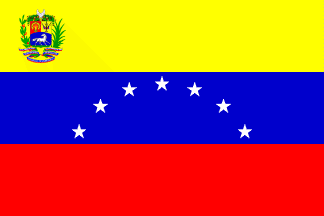
«Palavras para quê? O petróleo é uma arma. Política e poderosa. E a Venezuela tem muito. Em vésperas de Natal, foi notícia nos jornais de todo o mundo. O presidente da Venezuela, Hugo Chávez, opositor claro do capitalismo e da Administração Bush, que acusou mesmo de o tentar matar, venderá a preço de saldo (40 por cento abaixo do valor de mercado) 45 milhões de litros de combustível para aquecimento de casas e instituições de apoio aos milhares de norte-americanos pobres de Boston e Nova Iorque. Isto depois de ter já oferecido os seus préstimos aquando da destruição provocada pelos furacões Katrina e Rita. Para irritação da casa branca, foi assinado no final de Novembro um acordo entre a Citgo Petroleum Corp. - filial da companhia estatal de petróleo venezuelano - e duas organizações não governamentais de Boston - a Citizens Energy Consumers Alliance - para a distribuição da dávida do governo de Chávez. Os norte-americanos agradecem. George W. Bush talvez não»
Etiquetas: Política mundial
since 05.12.2005